Khoshroo, A., R. Mulwa, A. Emrouznejad and B. Arabi (2013), “A Non-Parametric Data Enveloped Analysis Approach for Improving Energy Efficiency of Grape Production,” Energy, Accepted, In Press

Khoshroo, A., R. Mulwa, A. Emrouznejad and B. Arabi (2013), “A Non-Parametric Data Enveloped Analysis Approach for Improving Energy Efficiency of Grape Production,” Energy, Accepted, In Press

Grape is one of the world’s largest fruit crops with approximately 67.5 million tonnes produced each year and energy is an important element in modern grape productions as it heavily depends on fossil and other energy resources. Efficient use of these energies is a necessary step toward reducing environmental hazards, preventing destruction of natural resources and ensuring agricultural sustainability. Hence, identifying excessive use of energy as well as reducing energy resources is the main focus of this paper to optimize energy consumption in grape production.
In this study we use a two-stage methodology to find the association of energy efficiency and performance explained by farmers’ specific characteristics. In the first stage a non-parametric Data Envelopment Analysis is used to model efficiencies as an explicit function of human labor, machinery, chemicals, farmyard manure (FYM), diesel fuel, electricity and water for irrigation energies. In the second step, farm specific variables such as farmers’ age, gender, level of education and agricultural experience are used in a Tobit regression framework to explain how these factors influence efficiency of grape farming.
The result of the first stage shows substantial inefficiency between the grape producers in the studied area while the second stage shows that the main difference between efficient and inefficient farmers was in the use of chemicals, diesel fuel and water for irrigation. The use of chemicals such as insecticides, herbicides and fungicides were considerably less than inefficient ones. The results revealed that the more educated farmers are more energy efficient in comparison with their less educated counterparts.

Gattoufi S., G. R. Amin, A. Emrouznejad (2013). “A new inverse DEA method for merging banks.” IMA Journal of Management Mathematics, Accepted, In Press

Gattoufi S., G. R. Amin, A. Emrouznejad (2013). “A new inverse DEA method for merging banks.” IMA Journal of Management Mathematics, Accepted, In Press

This study suggests a novel application of Inverse Data Envelopment Analysis (InvDEA) in strategic decision making about mergers and acquisitions in banking. The conventional DEA assesses the efficiency of banks based on the information gathered about the quantities of inputs used to realize the observed level of outputs produced. The decision maker of a banking unit willing to merge/acquire another banking unit needs to decide about the inputs and/or outputs level if an efficiency target for the new banking unit is set. In this paper, a new InvDEA-based approach is developed to suggest the required level of the inputs and outputs for the merged bank to reach a predetermined efficiency target. This study illustrates the novelty of the proposed approach through the case of a bank considering merging with or acquiring one of its competitors to synergize and realize higher level of efficiency. A real data set of 42 banking units in Gulf Corporation Council countries is used to show the practicality of the proposed approach.

Zerafat Angiz L., M., A. Emrouznejad, Adli Mustafa and Joshua Ignatius (2013). “Type-2 TOPSIS: A group decision problem when ideal values are not extreme endpoints.” Group Decision and Negotiation Accepted, In Press.

Zerafat Angiz L., M., A. Emrouznejad, Adli Mustafa and Joshua Ignatius (2013). “Type-2 TOPSIS: A group decision problem when ideal values are not extreme endpoints.” Group Decision and Negotiation Accepted, In Press.

In the traditional TOPSIS, the ideal solutions are assumed to be located at the endpoints of the data interval. However, not all performance attributes possess ideal values at the endpoints.We termed performance attributes that have ideal values at extreme points as Type-1 attributes. Type-2 attributes however possess ideal values somewhere within the data interval instead of being at the extreme end points. This provides a preference ranking problem when all attributes are computed and assumed to be of the Type-1 nature. To overcome this issue, we propose a new Fuzzy DEA method for computing the ideal values and distance function of Type-2 attributes in a TOPSISmethodology. Our method allows Type-1 and Type-2 attributes to be included in an evaluation system without compromising the ranking quality. The efficacy of the proposed model is illustrated with a vendor evaluation case for a high-tech investment decision making exercise. A comparison analysis with the traditional TOPSIS is also presented.

Mulwa, R. and A. Emrouznejad (2013) “Measuring Productive Efficiency Using Nerlovian Profit Efficiency Indicator and Meta-Frontier Analysis”. Operations Research: International Journal, 13:271–287, DOI: 10.1007/s12351-011-0119-1,

Mulwa, R. and A. Emrouznejad (2013) “Measuring Productive Efficiency Using Nerlovian Profit Efficiency Indicator and Meta-Frontier Analysis”. Operations Research: International Journal, 13:271–287, DOI: 10.1007/s12351-011-0119-1, Accepted, In Press.

The aim of this paper is to illustrate the measurement of productive efficiency using Nerlovian indicator and metafrontier with data envelopment analysis techniques. Further, we illustrate how profit efficiency of firms operating in different regions can be aggregated into one overarching frontier. Sugarcane production in three regions in Kenya has been used to illustrate these concepts. Results show that the sources of inefficiency in all regions are both technical and allocative, but allocative efficiency contributes more to the overall Nerlovian (in)efficiency indicator.

Hatami-Marbini, A., P. J. Agrell, M. Tavana and A. Emrouznejad (2013) “A Stepwise Fuzzy Linear Programming Model with Possibility and Necessity Relation,” Journal of Intelligent and Fuzzy Systems, 25 (2013) 81–93

Hatami-Marbini, A., P. J. Agrell, M. Tavana and A. Emrouznejad (2013) “A Stepwise Fuzzy Linear Programming Model with Possibility and Necessity Relation,” Journal of Intelligent and Fuzzy Systems, 25 (2013) 81–93.

Linear programming (LP) is the most widely used optimization technique for solving real-life problems because of its simplicity and efficiency. Although conventional LP models require precise data, managers and decision makers dealing with real-world optimization problems often do not have access to exact values. Fuzzy sets have been used in the fuzzy LP (FLP) problems to deal with the imprecise data in the decision variables, objective function and/or the constraints. The imprecisions in the FLP problems could be related to (1) the decision variables; (2) the coefficients of the decision variables in the objective function; (3) the coefficients of the decision variables in the constraints; (4) the right-hand-side of the constraints; or (5) all of these parameters. In this paper, we develop a new stepwise FLP model where fuzzy numbers are considered for the coefficients of the decision variables in the objective function, the coefficients of the decision variables in the constraints and the right-hand-side of the constraints. In the first step, we use the possibility and necessity relations for fuzzy constraints without considering the fuzzy objective function. In the subsequent step, we extend our method to the fuzzy objective function. We use two numerical examples from the FLP literature for comparison purposes and to demonstrate the applicability of the proposed method and the computational efficiency of the procedures and algorithms.

Amin, G. R., A. Emrouznejad (2013). “A new DEA model for technology selection in the presence of ordinal data.” International Journal of Advanced Manufacturing Technology, 65 (9-12) 1567.

Amin, G. R., A. Emrouznejad (2013). “A new DEA model for technology selection in the presence of ordinal data.” International Journal of Advanced Manufacturing Technology, 65 (9-12) 1567.

This paper suggests a data envelopment analysis (DEA) model for selecting the most efficient alternative in advanced manufacturing technology in the presence of both cardinal and ordinal data. The paper explains the problem of using an iterative method for finding the most efficient alternative and proposes a new DEA model without the need of solving a series of LPs. A numerical example illustrates the model, and an application in technology selection with multi-inputs/multi-outputs shows the usefulness of the proposed approach

OR Society DEA Course – One day training May 2014

The next OR Society one day DEA training course will be held in May 2014

Please see details at http://deazone.com/en/course/course-orsdea-2014

One Day DEA Course – September 10, 2013, Porto

Course Objective
Participants will be introduced to a set of parametric, semi- and non-parametric econometric models with applications that illustrate each of the models. The applications will include production, cost, distance functions, etc. Special emphasis will be given to modelling and estimating production/cost efficiency models. By the end of the class participants will be able to undertake a research project using either parametric and/or semi- and non-parametric approaches.
Instructor
Professor Subal C. Kumbhakar, State University of New York, Binghamton, New York, kkar@binghamton.edu

Topics
(a) Introduction of production and distance functions
(b) Cross-Sectional Methods
(i) Maximum Likelihood Methods
(ii) Determinants of Inefficiency
(c) Estimating Firm-Specific Inefficiency
(d) Panel Data Methods
(e) Measurement of Technical Change, TFP Change, Profitability Change
(f) Semi- and non-parametric methods for estimating SF models.
Cost
The price of this course is 150 Euro, including lunch and coffee breaks.
Venue
Room: 2
Business School
Universidade Católica Portuguesa
Rua Diogo botelho, 1327
Porto
Registration ( click here )
Registration and payment should be completed until the 31 of August

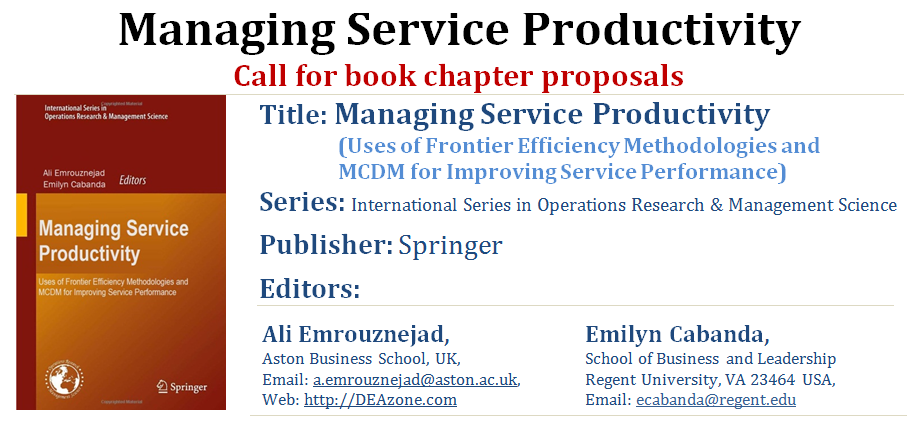
Managing Service Productivity: Call for book chapter proposals

Modern economies are emerging to meet and satisfy higher expectations for efficient and effective services. Managing service productivity examines complex service issues, challenges, operations and suggests the use of appropriate benchmarking techniques to improve service performance.

We have taken the initiative to edit the book on “Managing Service Productivity”. This book describes how the frontier efficiency methodology such as DEA and other techniques such as MCDM could help service industry to improve their performance by (1) providing ranking of best-practice efficient service units, (2) identifying sources of inefficiency for each service unit (3) determining potential improvement targets for each of the inefficient service units, (4) identifying peers for each service organization, and (5) providing a basis for continuous performance improvement. This information could be useful for the service management to improve service productivity, profitability, sustainability, and quality and effectiveness of service deliveries.
We aim to provide a collection of recent and state-of-the-art contributions to this emerging topic, and will be published in the “International Series in Operations Research & Management Science” (Springer).

We wish to invite you to contribute to this edited book. We are interested in topics including, but not limited to, service productivity in healthcare, education, financial services, transports, utilities, information technology, and tourism and leisure activities. We hope that you will be able to accept our invitation. At this stage, we invite you to submit [by December 15, 2012] a 1-2 page chapter proposal clearly explaining the goals and objectives of your proposed chapter.

Selection process and timeline

Since timeliness is crucial to the success of this editorial project, we would assume the following schedule:

Chapter proposals January 31, 2013
Decisions from editors February 15, 2013
Full submission of chapters April 30, 2013
Feedback of reviews May 31, 2013
Revised chapter submission July 31, 2013
Final acceptance notifications October 31, 2013


For further details please see: http://deazone.com/en/service-productivity-book

A call for proposals is available at http://deazone.com/service-productivity-book/chapter-proposal.pdf if you wish to share it with colleagues.

DEA2013: 11th International Conference on Data Envelopment Analysis, June 28-30, 2013 at Hill Hotel in OnDokuz Mayis University Campus of Samsun, TURKEY

DEA2013: 11th International Conference on Data Envelopment Analysis, June 27-30, 2013 at Hill Hotel in OnDokuz Mayis University Campus of Samsun, TURKEY, for detials please click here