


data envelopment analysis data envelopment analysis
Author's posts
Projected point
Refers to an inefficient DMU’s composite unit to emphasise that geometrically it involves the projection of the inefficient DMU onto the efficiency frontier (Ali and Seiford 1993). [Ali A and Seiford L (1993), ‘The mathematical programming approach to efficiency analysis’, in: Fried H, Knox C A K and Schmidt S (editors), The measurement of productive …
Productivity
For a single input-output case, the ratio of a unit’s output to its input. Productivity varies according to changes that occur in the production technology, the efficiency of the production process (which can be measured through DEA) and the production environment (Lovell 1993). [Lovel C A K (1993), ‘Productive frontiers and productive efficiency’, in: Fried …
Production function
Given a set of inputs that produce outputs, the production function defines an optimum relationship for producing the maximal amount of output from the given inputs. The DEA equivalent of the production function is the efficiency frontier which is based on empirical data (inputs and outputs). See Chames et al (1981) for details and more …
Primal (CCR) model
The primal model allows the DMU being measured to determine the set of optimal weights for each of its factors (outputs are denoted by y. and inputs by x in the following model) so as to maximise its efficiency. The solution consists of a set of weights (for outputs and y for inputs) chosen so …
Piecewise linearity
An efficiency frontier is piecewise linear when the underlying production function is approximated through interconnected linear segments. The basic DEA models are all piecewise linear. See Chames et al (1981) for implications. [Chames A, Cooper W W and Rhodes E (1981), ‘Evaluating program and managerial efficiency: an application of data envelopment analysis to program follow …
Peer group
Another name for reference set
Pareto-efficiency/Pareto-Koopmans efficiency:
Simply stated, a unit is Pareto-efficient when an attempt to improve on any of its inputs or outputs will adversely affect some other inputs or outputs. Formally, Chames et al (1981) consider a DMU to be 100% efficient only when ‘none of its inputs can be decreased without either (i) decreasing some of its outputs, …
Overall efficiency
Same as aggregate efficiency
Output-oriented
In an output-oriented model, an inefficient unit is made efficient through the proportional increase of its outputs, while the inputs proportions remain unchanged.
Output
A factor which describes the amount of goods, services or other outcome obtained as a result of the processing of resources. Also, any factor which describes the qualitative nature of the resulting outcome.
 Download
Mergoni, A. A. Emrouznejad, and K. De Witte (2025) Fifty years of Data Envelopment Analysis, European Journal of Operational Research, 326 (3): 389-412, https://doi.org/10.1016/j.ejor.2024.12.049.

DEA Workshop: Efficiency and Productivity Assessment in Higher Education and Public Services: DEA, Machine Learning, and AI, April 16-17, 2026, Aston University, UK
 DEA Course (CLICK HERE)
Dates:
Friday, June 12, 2026 – 10.00 to 17.30 (UK time)
Saturday, June 13, 2026 – 10.00 to 17.30 (UK time)
Presenters:
Professor Emmanuel Thanassoulis &
Professor Ali Emrouznejad
by Ali Emrouznejad & Rajiv Banker


William W Cooper
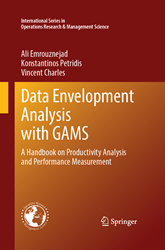
Order at Amazon – Download GAMS codes
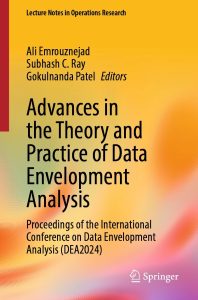 Download
 Download
Performance Improvement Management Software – PIM-DEA software
Managing Service Productivity : Uses of Frontier Efficiency Methodologies and MCDM for Improving Service Performance, Springer

Order at Amazon

Download | Recommend to Library
LinkedIn | Facebook | Twitter
 Download
Performance Measurement with Fuzzy DEA, Springer

Order at Amazon

Order at Amazon
Strategic Performance Management &
Measurement Using DEA. IGI Global, USA.

Order at Amazon