


data envelopment analysis data envelopment analysis
Author's posts
Weights
These are the unknowns in the primal model that determine the importance attributed to each factor. Since the value assigned to each weight depends on the measurement scale of the factor itself, it is difficult to compare the weights from different factors.
Weight Flexibility
As the CCR primal model places no restriction on the weights other than a lower bound of epsilon, it is not rare for a unit to be rated efficient at the expense of having a very uneven distribution of weights where some or most of the factors have been practically ignored. To remedy the situation, …
Visualisation
The process of developing a set of visual techniques such as graphs and charts through which the DEA results can be better understood.
Virtual multipliers
Another name for weights
Virtual input(output)
Virtual input is obtained for each input by taking the product of the input’s value and its corresponding optimal weight as given by the solution to the primal model. Virtual outputs are obtained analogously. A virtual input or output describes the importance attached to the given factor. The virtual inputs always add up to the …
Variable returns to scale
If it is suspected that an increase in inputs does not result in a proportional change in the outputs, a model which allows variable returns to scale (VRS) such as the BCC model should be considered.
Variable
An input or output factor. Since these are always known beforehand, their values are actually constants.
Units invariance
The efficiency scores of the DEA ratio models are independent of the units in which the factors are measured. The input and output values can thus be scaled through multiplication by a constant as proven in Chames and Cooper (1985). [Charnes A, Cooper W W (1985) ‘Preface to topics in data envelopment analysis’, in Thompson …
Unit isoquant/Isoquant
Yet another name for the efficiency frontier, this term emphasises the fact that each segment of the frontier represents the trade-off possibilities that can be made between the inputs or outputs of a given DMU on the isoquant segment while keeping the DMU efficient.
Unit
Short for decision making unit or DMU.
 Download
Mergoni, A. A. Emrouznejad, and K. De Witte (2025) Fifty years of Data Envelopment Analysis, European Journal of Operational Research, 326 (3): 389-412, https://doi.org/10.1016/j.ejor.2024.12.049.

DEA Workshop: Efficiency and Productivity Assessment in Higher Education and Public Services: DEA, Machine Learning, and AI, April 16-17, 2026, Aston University, UK
 DEA Course (CLICK HERE)
Dates:
Friday, June 12, 2026 – 10.00 to 17.30 (UK time)
Saturday, June 13, 2026 – 10.00 to 17.30 (UK time)
Presenters:
Professor Emmanuel Thanassoulis &
Professor Ali Emrouznejad
by Ali Emrouznejad & Rajiv Banker


William W Cooper
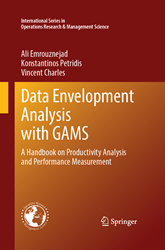
Order at Amazon – Download GAMS codes
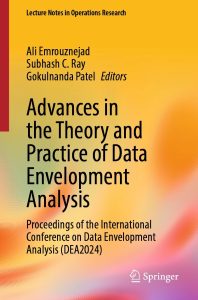 Download
 Download
Performance Improvement Management Software – PIM-DEA software
Managing Service Productivity : Uses of Frontier Efficiency Methodologies and MCDM for Improving Service Performance, Springer

Order at Amazon

Download | Recommend to Library
LinkedIn | Facebook | Twitter
 Download
Performance Measurement with Fuzzy DEA, Springer

Order at Amazon
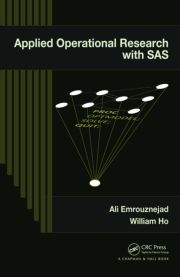
Order at Amazon
Strategic Performance Management &
Measurement Using DEA. IGI Global, USA.

Order at Amazon