


data envelopment analysis data envelopment analysis
Author's posts
Outlier
Generally taken to mean an odd unit with an input-output mix that significantly differs from the rest of the units. This can be due to a measurement error, or as a result of the outlier having different operating practices. Outliers that are efficient can introduce bias into the analysis. See Epstein and Henderson (1989). [Epstein …
Ordinal variable
A factor which consists of a set of predefined values that are ranked in a specific order. An ordinal variable can be seen as a special case of a categorical variable. If the values of an ordinal factor need to be scaled, the inherent order must be preserved (Cook et al 1993). [Cook W, Kress …
Non-naturally enveloped unit
Bessent et al (1988) coined this term (later simply known as unenveloped units) to refer to those inefficient units that are not fully enveloped by the efficiency frontier. To be fully enveloped in the CCR model, an inefficient DMU needs to have (m+n) -1 reference units where m+n denotes the number of factors. Unenveloped units …
Nondiscretionary factor
Same as exogenously fixed factor.
Multiplier form
Associated with each DEA model type (eg CCR, BCC) is both a primal and dual formulation. To avoid confusion over which formulation is primal and which dual, the multiplier form is always understood to refer to the formulation involving virtual multipliers (Ali and Seiford 1993). [Ali A and Seiford L (1993), ‘The mathematical programming approach …
Most productive scale size (MPSS)
MPSS is a unit (point) on the efficiency frontier that maximises the average productivity for its given input-output mix and after which decreasing returns to scale set in. See Banker & Kemerer (1989) on how to compute the MPSS. [Banker R and Kemerer C (1989) ‘Scale economies in new software development’, IEEE Trans. On Softw. …
Isotonicity
The requirement that the relationship between inputs and outputs not be erratic. Increasing the value of any input while keeping other factors constant should not decrease any output but should instead lead to an increase in the value of at least one output.
An introduction to efficiency and productivity analysis … By Tim Coelli
[Click here to return to all books.] close all Button [Click here to return to all books.]
Dynamics of data envelopment analysis: theory of systems efficiency … By Jatikumar Sengupta
[Click here to return to all books.] close all Button [Click here to return to all books.]
Introduction to the theory and application of data envelopment analysis … By Emmanuel Thanassoulis
[Click here to return to all books.] close all Button [Click here to return to all books.]
 Download
Mergoni, A. A. Emrouznejad, and K. De Witte (2025) Fifty years of Data Envelopment Analysis, European Journal of Operational Research, 326 (3): 389-412, https://doi.org/10.1016/j.ejor.2024.12.049.

DEA Workshop: Efficiency and Productivity Assessment in Higher Education and Public Services: DEA, Machine Learning, and AI, April 16-17, 2026, Aston University, UK
 DEA Course (CLICK HERE)
Dates:
Friday, June 12, 2026 – 10.00 to 17.30 (UK time)
Saturday, June 13, 2026 – 10.00 to 17.30 (UK time)
Presenters:
Professor Emmanuel Thanassoulis &
Professor Ali Emrouznejad
by Ali Emrouznejad & Rajiv Banker


William W Cooper
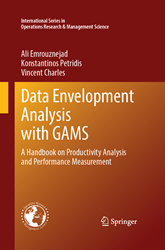
Order at Amazon – Download GAMS codes
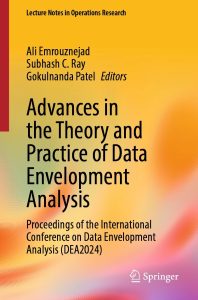 Download
 Download
Performance Improvement Management Software – PIM-DEA software
Managing Service Productivity : Uses of Frontier Efficiency Methodologies and MCDM for Improving Service Performance, Springer

Order at Amazon

Download | Recommend to Library
LinkedIn | Facebook | Twitter
 Download
Performance Measurement with Fuzzy DEA, Springer

Order at Amazon

Order at Amazon
Strategic Performance Management &
Measurement Using DEA. IGI Global, USA.

Order at Amazon