

A unit is said to be scale efficient when its size of operations is optimal so that any modifications on its size will render the unit less efficient. The value for scale efficiency is obtained by dividing the aggregate efficiency by the technical efficiency.
Well-rounded performance
If a DMU is rated efficient and more or less equal importance has been given to each of its factors, it is said to exhibit well-rounded performance.
Outlier
Generally taken to mean an odd unit with an input-output mix that significantly differs from the rest of the units. This can be due to a measurement error, or as a result of the outlier having different operating practices. Outliers that are efficient can introduce bias into the analysis. See Epstein and Henderson (1989). [Epstein M K and Henderson J C (1989) ‘Data envelopment analysis for managerial control and diagnosis’, Decision Sciences, 20, pp 90-119.]
Scale of operations
The so-called ‘size’ of the DMU, it may be associated with either the inputs or the outputs, depending on the situation.
Window analysis
Tabular method for examining the changes in the efficiencies of a set of units over time. A set of time periods (1 ..t) is chosen and the efficiency of each unit (1..n) is computed separately for each period so that the efficiency of a given unit over each period is treated as a new unit resulting in a total number of tn units.
Output
A factor which describes the amount of goods, services or other outcome obtained as a result of the processing of resources. Also, any factor which describes the qualitative nature of the resulting outcome.
Slacks
The additional improvement (increase in outputs and/or decrease in inputs) needed for a unit to become efficient.
Output-oriented
In an output-oriented model, an inefficient unit is made efficient through the proportional increase of its outputs, while the inputs proportions remain unchanged.
Targets
The input and output values that would render an inefficient unit relatively efficient. Thanassoulis and Dyson (1992) examine ways of modifying the DEA model so as to set priorities over which targets should be improved. [Thanassoulis E and Dyson R G (1992) ‘Estimating preferred target input-output levels using data envelopment analysis’, J. of Opi. Res., 56, pp 80-97.]
Overall efficiency
Same as aggregate efficiency
 Download
Mergoni, A. A. Emrouznejad, and K. De Witte (2025) Fifty years of Data Envelopment Analysis, European Journal of Operational Research, 326 (3): 389-412, https://doi.org/10.1016/j.ejor.2024.12.049.

DEA Workshop: Efficiency and Productivity Assessment in Higher Education and Public Services: DEA, Machine Learning, and AI, April 16-17, 2026, Aston University, UK
 DEA Course (CLICK HERE)
Dates:
Friday, June 12, 2026 – 10.00 to 17.30 (UK time)
Saturday, June 13, 2026 – 10.00 to 17.30 (UK time)
Presenters:
Professor Emmanuel Thanassoulis &
Professor Ali Emrouznejad
by Ali Emrouznejad & Rajiv Banker


William W Cooper
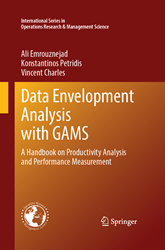
Order at Amazon – Download GAMS codes
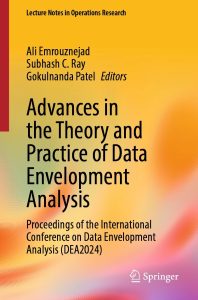 Download
 Download
Performance Improvement Management Software – PIM-DEA software
Managing Service Productivity : Uses of Frontier Efficiency Methodologies and MCDM for Improving Service Performance, Springer

Order at Amazon

Download | Recommend to Library
LinkedIn | Facebook | Twitter
 Download
Performance Measurement with Fuzzy DEA, Springer

Order at Amazon

Order at Amazon
Strategic Performance Management &
Measurement Using DEA. IGI Global, USA.

Order at Amazon