


data envelopment analysis data envelopment analysis
Author's posts
DEA algorithm
Although DEA models can usually be solved with a standard LP solver, it is recommended to use specifically tailored DEA algorithms for increased accuracy and speed. Such algorithms avoid the computational problems with epsilon and make use of the fact that a unit found to be inefficient can be removed from the basis as it …
What is Data Envelopment Analysis?
Data Envelopment Analysis is a decision making tool based on linear programming for measuring the relative efficiencies of a set of comparable units. DEA is intitaly developed by Charnes, Cooper, Rhodes (1978).
Composite unit
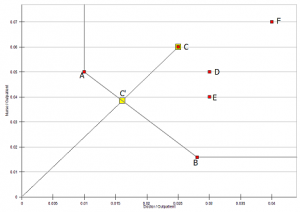
A hypothetical efficient unit formed from a DMU’s reference units according to the proportions indicated by the dual weights. In Figure , the hypothetical unit for E lies at E’, defined by the reference units B and C.
CCR (ratio) mode
Named after its developer Chames, Cooper and Rhodes, this is the first and fundamental DEA model, built on the notion of efficiency as defined in the classical engineering ratio. The CCR ratio model calculates an overall efficiency for the unit in which both its pure technical efficiency and scale efficiency are aggregated into a single …
Categorical variable
A factor which can assume only a predefined set of discrete values. Categorical variables are frequently used to indicate the presence or absence of an attribute. An analysis on fast-food restaurants could use a categorical variable assigned to I to indicate the presence of a drive-in window, with the value O denoting its absence. The …
DEA results are biased
Generally speaking, the results are biased if they favour a particular unit and/or unfairly assess the efficiency of some inefficient units. Although the actual DEA technique can be considered fair, bias can be introduced into the analysis through the omission of a critical factor or a lack of homogeneity in the field.
7th North American Productivity Workshop, June 6-9 – 2012, Houston, Texas
VII North American Productivity Workshop June 6-9 – 2012 Rice University, Houston, Texas for further information please see http://economics.rice.edu/~napw2012/
The 8th Asia-Pacific Productivity Conference, July 25-27, 2012, KMITL, Bangkok, Thailand
The 8th Asia-Pacific Productivity Conference, July 25-27, 2012, KMITL, Bangkok, Thailand for further detail splease see: http://www.APPC2012.org
DEA Symposium, February 20-21, Japan
DEA (Data Envelopment Analysis) Symposium 2012 will take place at Seikei University in Tokyo from February 20th to 21st, 2012, celebrating the 100th anniversary of Seikei Gakuen. For further details please see: http://xserv0.ci.seikei.ac.jp/DEA2012/
Emrouznejad, A. and G. R. Amin (2010). “Improving minimax disparity model to determine the OWA operator weights.” Information Sciences 180(8): 1477-1485.
Emrouznejad, A. and G. R. Amin (2010). “Improving minimax disparity model to determine the OWA operator weights.” Information Sciences 180(8): 1477-1485. Determining the Ordered Weighted Averaging (OWA) operator weights is important in decision making applications. Several approaches have been proposed in the literature to obtain the associated weights. This paper provides an alternative disparity model …
 Download
Mergoni, A. A. Emrouznejad, and K. De Witte (2025) Fifty years of Data Envelopment Analysis, European Journal of Operational Research, 326 (3): 389-412, https://doi.org/10.1016/j.ejor.2024.12.049.

DEA Workshop: Efficiency and Productivity Assessment in Higher Education and Public Services: DEA, Machine Learning, and AI, April 16-17, 2026, Aston University, UK
 DEA Course (CLICK HERE)
Dates:
Friday, June 12, 2026 – 10.00 to 17.30 (UK time)
Saturday, June 13, 2026 – 10.00 to 17.30 (UK time)
Presenters:
Professor Emmanuel Thanassoulis &
Professor Ali Emrouznejad
by Ali Emrouznejad & Rajiv Banker


William W Cooper
Order at Amazon – Download GAMS codes
 Download
 Download
Performance Improvement Management Software – PIM-DEA software
Managing Service Productivity : Uses of Frontier Efficiency Methodologies and MCDM for Improving Service Performance, Springer

Order at Amazon

Download | Recommend to Library
LinkedIn | Facebook | Twitter
 Download
Performance Measurement with Fuzzy DEA, Springer

Order at Amazon
Order at Amazon
Strategic Performance Management &
Measurement Using DEA. IGI Global, USA.

Order at Amazon