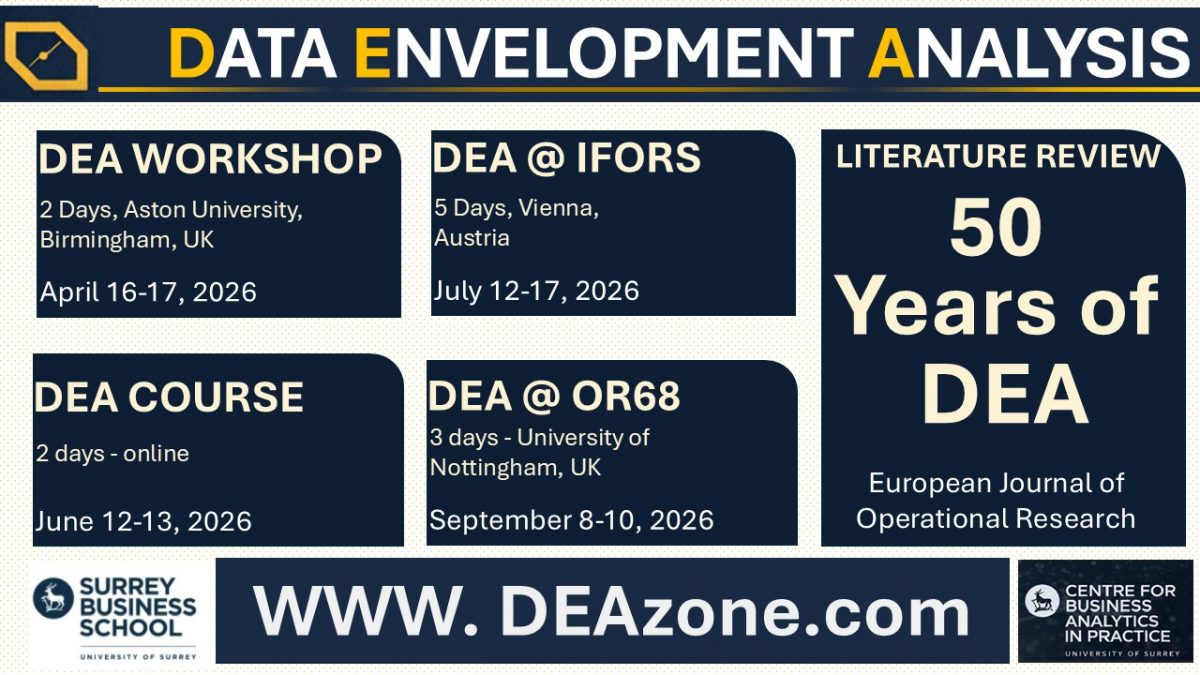
In addition, the following review paper on DEA might be of interest to you.
Fifty Years of Data Envelopment Analysis Mergoni, A., Emrouznejad, A., & De Witte, K. (2025). Fifty years of Data Envelopment Analysis. European Journal of Operational Research, 326(3), 389–412. https://doi.org/10.1016/j.ejor.2024.12.049
Further information about all activities can be found at: www.DEAzone.com
We very much hope you will be able to join us at one or more of these events and contribute to the continued development of the DEA field.
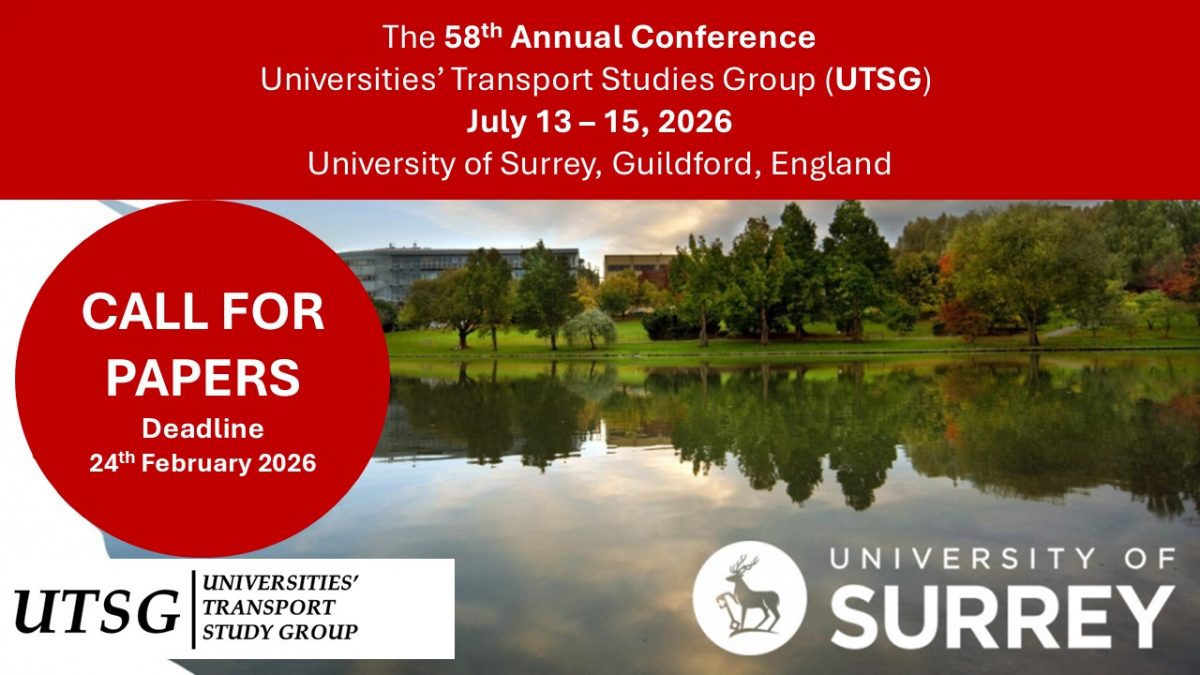
Call for Papers | 58th Universities’ Transport Studies Group (UTSG) Annual Conference University of Surrey, Guildford, England 13–15 July 2026
We are delighted to announce that Surrey will host the 58th UTSG Annual Conference – a flagship event now in its sixth decade, bringing together leading researchers, practitioners, and students from across the UK, Ireland, and beyond.
Keynote Speakers 13 July – Tim Schwanen, Director, Transport Studies Unit, University of Oxford 14 July – Shaun Helman, Chief Scientist, TRL 15 July – Bidisha Ghosh, Associate Professor, Trinity College Dublin
Conference Themes (including but not limited to):
Travel & Tourism
Energy in Transportation
Transport & Environment
Climate Change & Resilience
Intelligent Transport Systems (ITS)
Connected & Autonomous Vehicles (CAV)
Public Transport & Shared Mobility (MaaS)
Traffic Management & Safety
Transport Policy & Economics
Equity, Gender & Inclusion in Transport
Logistics & Freight
Accessibility & Urban Planning
Emerging Trends in Air & Water Transport
Selected papers will be considered for Special Issues in:
Taylor & Francis – Transportation Planning and Technology [https://www.tandfonline.com/journals/gtpt20]
Key Dates: Abstract submission (300 words + 6 keywords): 24 February 2026 Notification of acceptance: 25 March 2026 Full paper (max 12 pages) or Extended abstract (max 1500 words): 5 May 2026
PhD researchers are especially encouraged to participate and benefit from our dedicated training and mentoring sessions (open to all).
Smeed Prize: Eligible postgraduate researchers from UTSG member institutions (UK & Ireland) can compete for: £500 (Best Paper) £250 (Runner-up)
Venue & Location
The conference will take place at the Lecture Theatres, Stag Hill Campus, University of Surrey.Guildford is just over 30 minutes from London, with:
Direct train from Gatwick
Coach from Heathrow
Beautiful historic town centre
The stunning Surrey Hills as a backdrop
A full-course Gala Dinner will be held at picturesque Gorse Hill.
Local Organising Committee
Chaired by Nikolas Thomopoulos, and supported by colleagues including Abigail Bristow and Ali Emrouznejad, along with a dedicated team at Surrey.
Prof. Abigail Bristow
Prof. Ali Emrouznejad
Dr Yinglong (Ian) He
Dr James Kennell
Dr Jonathan Skinner
Dr Michael Pekris
Dr Lorna Wang
Dr Páraic Carroll
Dr Beatriz Martinez Pastor
We are very much looking forward to welcoming the transport research community to Surrey next summer. Administrative enquiries: utsg2026@surrey.ac.uk Submit your abstract via the UTSG submission system (see conference webpage above).
The rapid advancement of Large Language Models (LLMs) has significantly reshaped the landscape of data-driven decision-making in management. These models offer unprecedented capabilities to process natural language, generate insights, and support complex reasoning—complementing traditional mathematical and optimization frameworks used in managerial contexts. However, the true potential of LLMs in management science lies not merely in their standalone use, but in their thoughtful integration with established quantitative methodologies to enhance the precision, interpretability, and robustness of managerial decisions.
This special issue aims to bridge the gap between advanced natural language processing and the rigorous domain of management mathematics. We seek to explore how LLMs can be synergistically combined with mathematical modeling, optimization techniques, statistical analysis, and computational intelligence to address complex decision-making challenges. Such integration is particularly vital in areas characterized by uncertainty, large-scale data, and the need for real-time analytical responses.
Key areas of interest:
Key areas of interest include, but are not limited to:
Developing LLM-augmented optimization models capable of interpreting unstructured contextual information to dynamically refine model constraints and objectives.
Enhancing simulation and forecasting in supply chain management and operational logistics through advanced scenario generation and natural language-driven sensitivity analysis.
Designing hybrid intelligent systems in which LLMs support model formulation, parameter estimation, and result interpretation, thereby streamlining the end-to-end analytical process.
Investigating interactive decision support systems that enable managers to query, explore and manipulate complex analytical models through natural language interfaces, making advanced analytical tools more intuitive and accessible.
Objective:
By fostering a dialogue between AI researchers and management scientists, this special issue will highlight how LLMs can transform traditional mathematical approaches into more adaptive, intuitive, and powerful decision-making frameworks. We welcome theoretical advancements, novel methodologies, and practical case studies that demonstrate tangible impacts in fields such as finance, healthcare, logistics, public policy, and strategic planning.
The primary function of decision support systems in networks employing large language models is to emulate the decision-making capabilities of the human brain, thereby mitigating the limitations of mathematical models that are challenging to accurately and effectively address large language model (LLM) technology problems.
Scope and Topics:
For this special issue, we invite papers related to the following topics (but not limited to):
Mathematical Modelling Enhanced by LLMs for solving complex managerial and organizational decision problems.
Natural Language Interfaces and Cognitive Optimization, enabling intuitive interaction with mathematical and simulation-based decision systems.
LLMs in Management Science and Operations Research, including planning, forecasting, scheduling, and resource allocation.
Hybrid Quantitative–AI Frameworks, integrating LLMs with optimization, stochastic modelling, and systems analysis.
Interpretability, Verification, and Validation of LLM-supported quantitative decisions.
Empirical Studies and Analytical Applications of LLM-based management mathematics in finance, healthcare, logistics, and policy analysis.
Ethical and Governance Modelling in LLM-driven decision frameworks, including fairness, accountability, and bias mitigation.
Data Fusion and Model Integration using LLMs to extract, structure, and utilize knowledge from heterogeneous data sources.
Real-Time and Adaptive Decision Analytics, combining LLM reasoning with dynamic optimization and control theory.
Authors should submit a cover letter and a manuscript by December 31, 2026, via the Journal’s online submission site. Manuscripts submitted after the deadline may not be considered for the special issue and may be transferred, if accepted, to a regular issue.
Please see the Author instructions on the website. When submitting via our submission site, please select the special issue’s title “LLM and Management Mathematics” to ensure that it will be reviewed for this special issue.
Submitted papers should not have been previously published nor be currently under consideration for publication elsewhere. Papers will be subject to a strict review process managed by the Guest Editors, and accepted papers will be published online individually, before print publication.
Prof. Dr. Liurui Deng serves as Head of the Department of Finance at the Business School of Hunan Normal University. Her primary research interests include financial mathematics, financial risk management, investor behaviour, and predictive analysis of securities markets and economic indicators. As principal investigator, she has secured and led multiple national and ministerial-level research projects, including grants from the National Natural Science Foundation of China, the National Social Science Foundation of China, the Ministry of Education Humanities and Social Sciences Foundation, the Hunan Provincial Natural Science Foundation, and the Hunan Provincial Social Science Foundation, and so on. The total funding exceeds one million yuan, demonstrating strong academic leadership and competitive research capabilities.
William Yeoh
Lee Shau Kee School of Business and Administration, Hong Kong Metropolitan University, Hong Kong, wyeoh@hkmu.edu.hk
Prof. William Yeoh is an expert in business intelligence, big data analytics, and cybersecurity. His expertise includes doctoral supervision, academic publishing, and funding acquisition. He has received awards for research and teaching, including Researcher of the Year, ICT Educator of the Year, and recognition as one of Australia’s Top 25 Analytics Leaders. His leadership experience covers industry engagement, research coordination, and international collaborations at Deakin University, University of Ottawa, University of Indonesia, and UTAR. He is a Fellow of the Australian Computer Society (ACS).
Kelvin KL Wong
Department of Mechanical Engineering, University of Saskatchewan, Saskatoon, Canada, kelvin.wong@ieee.org
Prof. Dr. Kelvin KL Wong is an expert in medical image processing, computational science, and artificial intelligence (AI). He introduced “Cybernetical Intelligence” and was ranked among Stanford’s top 1.3% biomedical engineers in 2020. Dr. Wong has pioneered AI-driven healthcare solutions, including Deep Red, a tool for modular programming and deep learning model creation. He led the African Telehealth Network in Zambia, enhancing healthcare delivery. Dr. Wong is a Foreign Fellow of the Zambia Academy of Sciences and a Fellow of IEAust, with significant contributions to AI and telehealth.
Simon Fong
Department of Computer and Information Science, University of Macau, Macau, China, ccfong@umac.mo
Dr. Simon Fong is an Associate Professor at the University of Macau, specializing in data mining, big data analytics, meta-heuristic optimization algorithms, and their applications. He has authored over 445 papers and serves on the editorial boards of several high-impact journals. Dr. Fong co-founded the Data Analytics and Collaborative Computing Research Group. He holds leadership roles as Vice-Chair of the IEEE Computational Intelligence Society’s Task Force and Vice-Director of the International Consortium for Optimization and Modelling in Science and Industry. His research includes work in data stream mining and business intelligence.
Ali Emrouznejad
Professor and Chair in Business Analytics, Surrey Business School, University of Surrey, Guildford, UK, a.emrouznejad@surery.ac.uk
Ali Emrouznejad is a Professor and Chair in Business Analytics at Surrey Business School, UK. He also serves as the Director of the Centre for Business Analytics in Practice (CBAP), leading research in performance measurement and management, efficiency and productivity analysis, as well as AI and big data. Prof. Emrouznejad is the Editor-in-Chief of the Journal of Business Analytics. In addition, he holds roles as an editor, associate editor, department editor, or guest editor for various journals, including the European Journal of Operational Research, Journal of the Operational Research Society, Annals of Operations Research. OR Spectrum, RAIRO – Operations Research, Socio-Economic Planning Sciences, IMA Journal of Management Mathematics, among others.
He has published 25 books and over 250 articles in leading journals. He has been recognized by Stanford University as one of the top 2% most influential scientists worldwide. He is also member of the Business and Management panel for the UK Research Excellence Framework 2029.
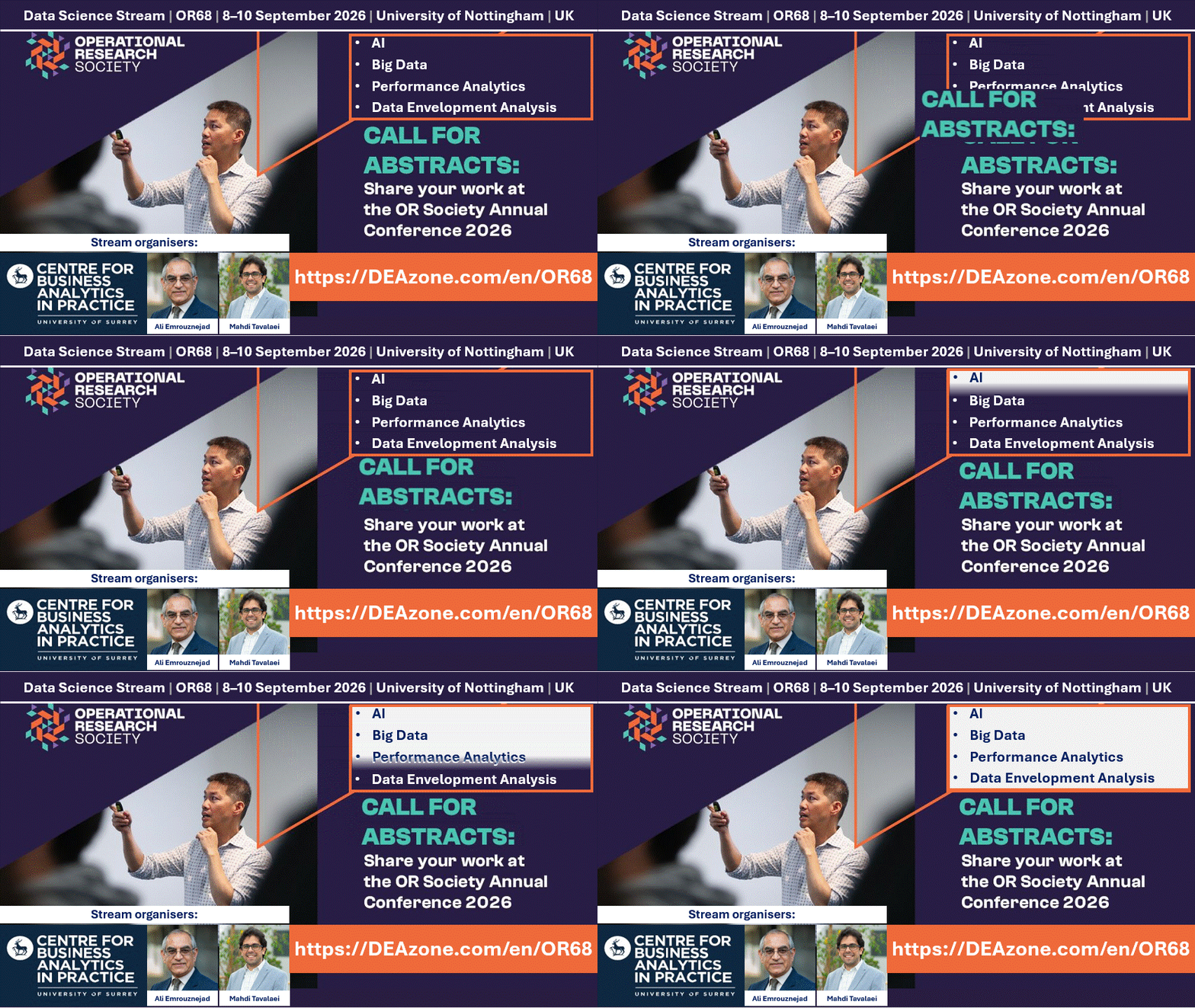
We would like to invite you to submit an abstract to the Data Science Stream: AI, Big Data, and Performance Analytics (Data Envelopment Analysis – DEA) at OR68 – The OR Society Annual Conference 2026, taking place on 8–10 September 2026 at the University of Nottingham, UK.
This stream brings together researchers and practitioners working at the intersection of AI, machine learning, big data analytics, optimisation, and performance measurement (including DEA), with an emphasis on methodological advances and impactful real-world applications.
We welcome contributions on topics including, but not limited to:
AI and machine learning, including deep learning, generative and foundation models
AI applications for business and market implications, including adoption, governance, competitive strategy, and trustworthy and explainable AI
Data-driven and hybrid optimisation, predictive and prescriptive analytics
Performance measurement and benchmarking, including Data Envelopment Analysis (DEA) and related OR-based efficiency and productivity analysis
Integration of AI with OR models, such as intelligent decision-support systems, automated model building, and AI-enhanced analytics and optimisation
Particular attention will be given to research that bridges data-centric and model-centric approaches, demonstrating how AI and OR together can improve decision-making, system resilience, and efficiency assessment in domains such as healthcare, energy, sustainability, finance, logistics, and transportation. The stream will feature academic paper sessions, invited talks, keynote presentations, and panel discussions to explore emerging trends, methodological innovations, and future research directions. By fostering interdisciplinary exchange, the stream aims to strengthen the connection between AI, data science, and OR, showcasing how rigorous analytical methodologies can drive both theoretical advancement and practical impact.
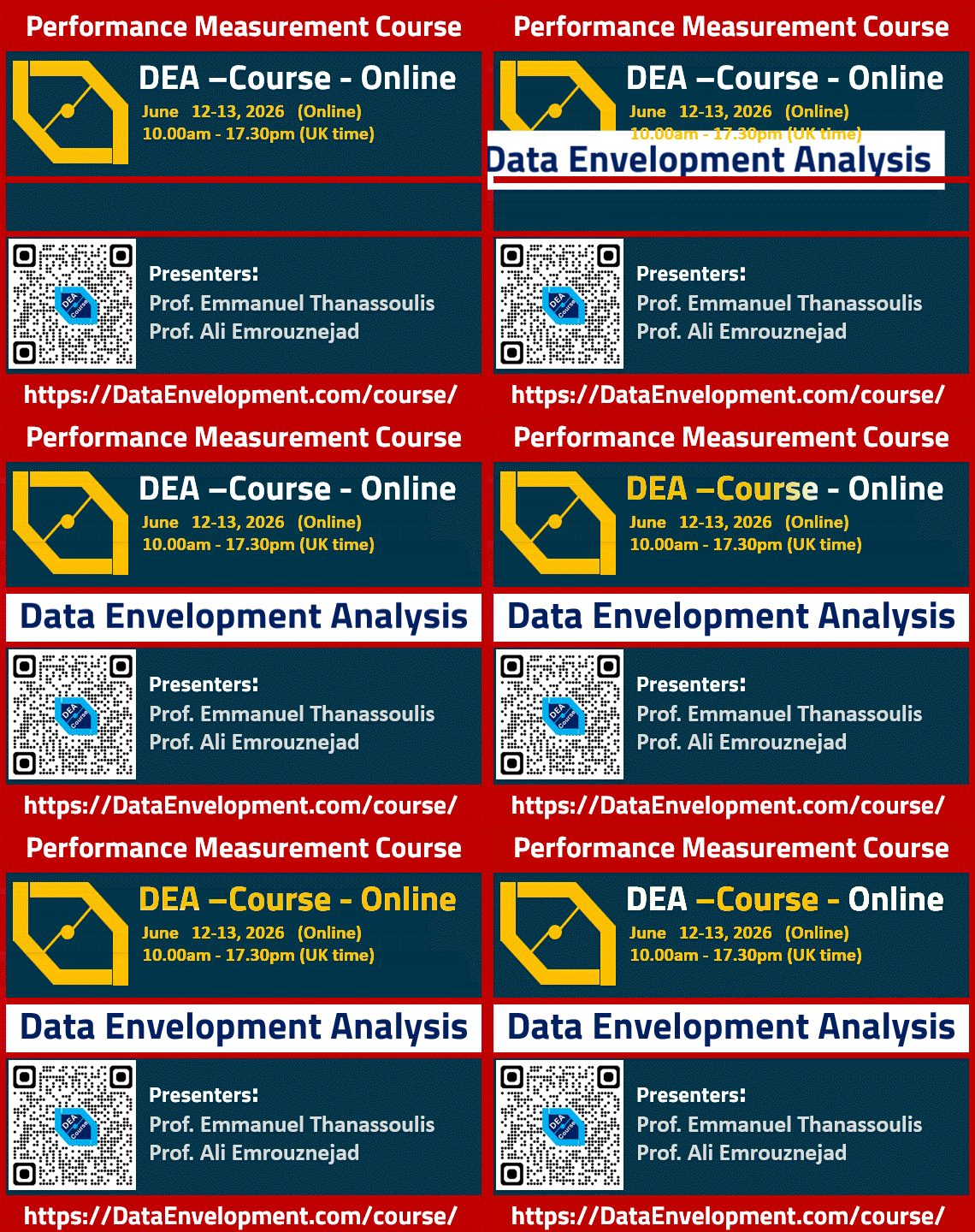
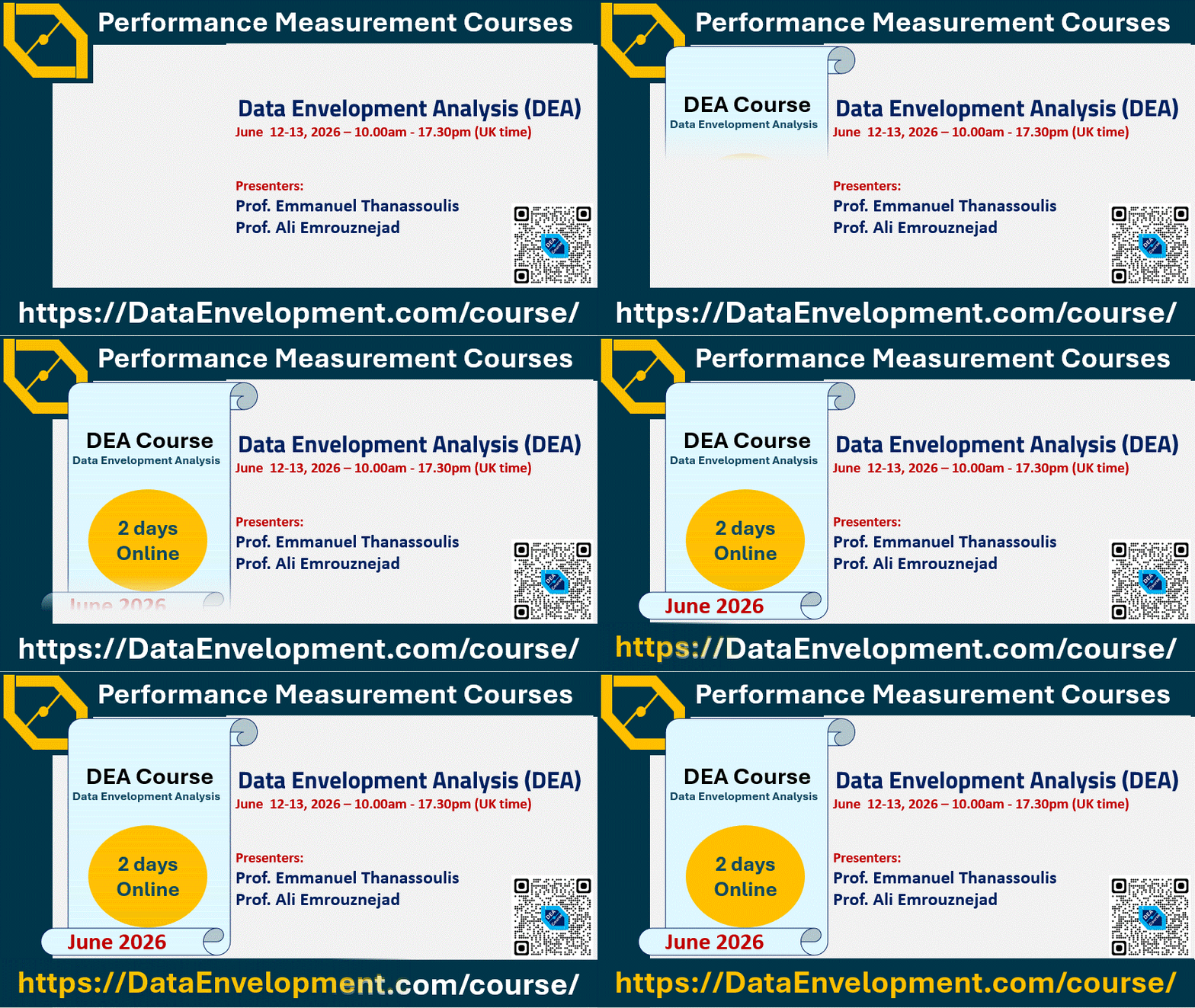
Join our Performance Measurement courses on Data Envelopment Analysis (DEA) led by renowned experts Prof. Emmanuel Thanassoulis, and Prof. Ali Emrouznejad
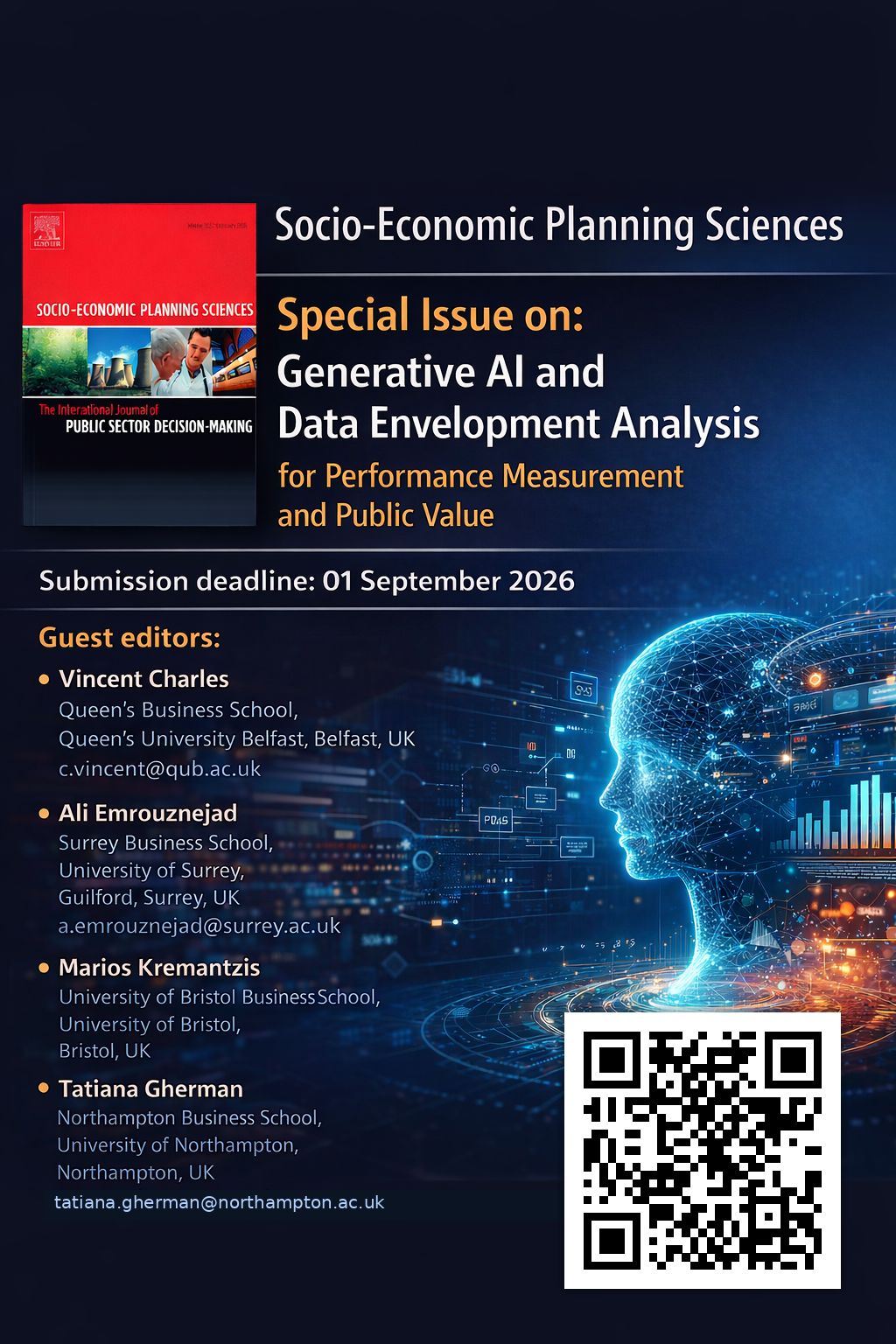
Call for Papers – Special Issue on Generative AI and Data Envelopment Analysis (DEA) for Performance Measurement and Public Value (Socio-Economic Planning Sciences, Q1, ABS2*)
Special Issue on: Generative AI and Data Envelopment Analysis (DEA) for Performance Measurement and Public Value Submission deadline: 01 September 2026 (CLICK HERE)
This Special Issue invites research that advances rigorous performance measurement in the age of GenAI by exploring the two-way relationship between GenAI and Data Envelopment Analysis (DEA): · How DEA can be used to assess efficiency/productivity and broader performance in GenAI-enabled systems and organisations (e.g., quality, risk, equity, reliability, footprint). · How GenAI can support or extend DEA, for example via data synthesis, model generation, interpretability, and bias correction.
Contributions should address one or more of the followings: 1. Methodological innovation in DEA inspired or enabled by GenAI (e.g., new DEA formulations, variable selection/frontier estimation supported by GenAI, bias correction, interpretability, synthetic-data validation with representativeness safeguards) 2. Empirically validated applications of DEA for evaluating AI-augmented processes (e.g., benchmarking GenAI-enabled vs conventional workflows across public services, education, health, finance, supply chains) 3. Analytical frameworks linking GenAI and DEA for improved decision-making, policy evaluation, or resource allocation (e.g., procurement and capacity planning for GenAI in public agencies/universities, productivity change over time)
Submission guidance Submit via Elsevier’s Editorial Manager for Socio-Economic Planning Sciences and select article type “VSI: GenAI and DEA”. (CLICK HERE)
I would like to issue an invitation to take part in the Data Envelopment Analysis and Performance Measurement Stream of the IFORS2026 Conference. This conference will be held on July 12 to 17, 2026 in Vienna, Austria. Contributions from both the academic and the non-academic communities are welcome. (see details at http://www.DEAzone.com/en/ifors2026).
This stream covers papers on the theme of efficiency and productivity analysis and performance management. Both parametric and non-parametric papers will be considered. We especially welcome papers on the theory, methodology and application of Data Envelopment Analysis and econometric methods in performance management. Of particular interest are successful applications of performance and efficiency analysis in the real world, for example in banking, healthcare, education, transportation, and so on.
If you are interested in making a presentation at https://ifors2026.at/home/ using the following session codes: – For DEA and SFA applications: “8b965d9e” – For DEA / SFA modeling and theory: “3334941e”
– If you are interested to organise a session on specific topic of DEA (or SFA) please contact me (ae0027@surrey.ac.uk). Each session normally consists of 4 papers.
Important dates: Deadline for submission abstract: March, 01, 2026. Early-bird Registration: April 25, 2026. Final registration: May 1, 2026 Conference date: July 12 to 17, 2026 Conference Venue: Vienna, Austria
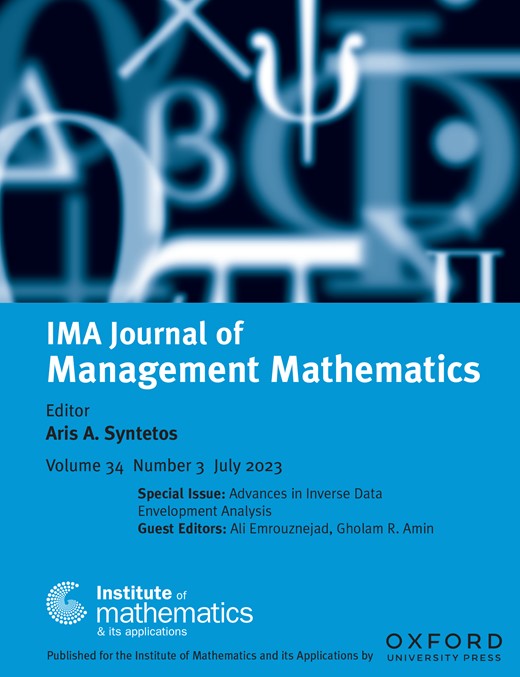
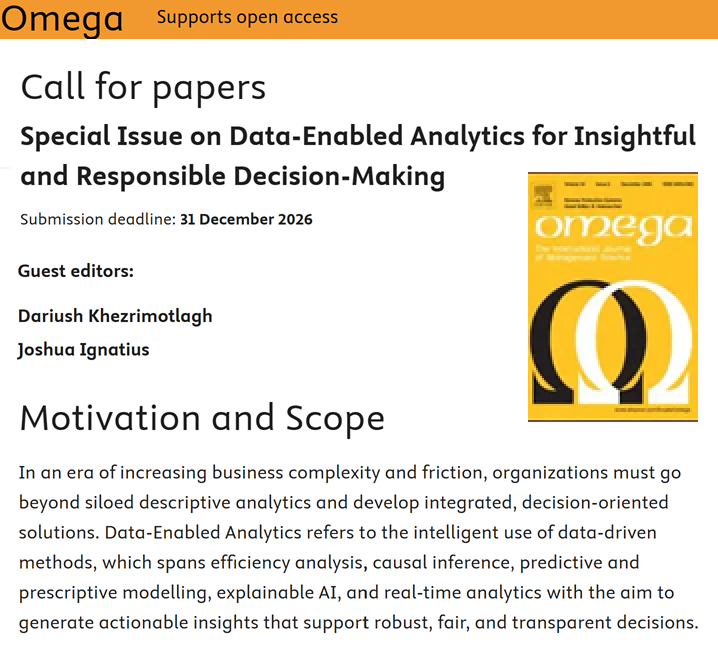
Special Issue on: “Data-Enabled Analytics for Insightful and Responsible Decision-Making” Submission Deadline: 31 December 2026 Submission Opens: 10 November 2025
Guest Editors: Prof. Dariush Khezrimotlagh School of Science, Engineering, and Technology, Pennsylvania State University – Harrisburg dk@psu.edu
Prof. Joshua Ignatius Department of Business Analytics and Information Systems, Aston Business School, Aston University (UK) j.ignatius@aston.ac.uk
Motivation and Scope
In today’s complex and dynamic environment, organizations must move beyond siloed descriptive analytics and adopt integrated, data-enabled approaches for decision-making. This special issue focuses on intelligent data-driven methods—including efficiency analysis, causal inference, machine learning, explainable AI, and real-time analytics—to support robust, fair, and transparent decisions.
We welcome contributions that push the boundaries of analytics to handle real-world complexity—balancing competing objectives, stakeholder interdependence, and the need for timely and trustworthy insights.
Topics of Interest
We invite submissions on (but not limited to): Hybrid analytics frameworks (e.g., DEA, ML, causal inference) Causal and predictive modeling for actionable insights Benchmarking and performance evaluation beyond surface metrics Fairness, ethics, and trustworthy AI Game-theoretic and strategic analytics for data-rich environments Human-centric and explainable decision support Real-time and dynamic analytics under uncertainty Empirical validation and industry collaboration
Expected Contributions
Submissions should:
Combine methodological rigor with practical relevance
Provide clear managerial or policy implications
Demonstrate empirical or simulation-based validation
How to Submit
When submitting to the journal’s editorial system , please select the article type: “VSI: Data-Enabled Analytics.”
Keywords: Data-enabled analytics · Hybrid frameworks · Causal and predictive modelling · Explainable and Responsible AI · Game-theoretic analytics · Performance analytics
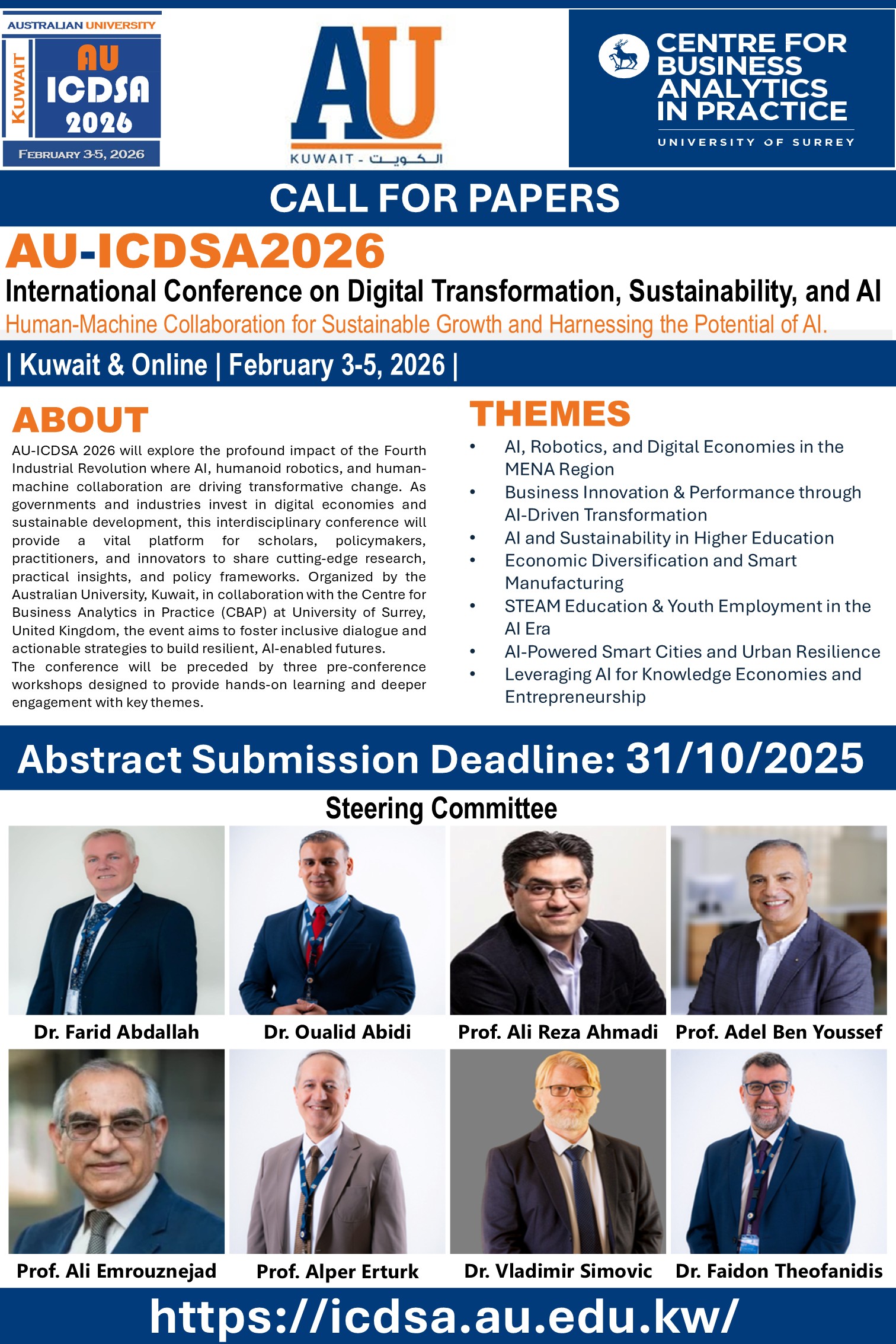
Call for Papers: AU-ICDSA2026 International Conference on Digital Transformation, Sustainability, & AI Human-Machine Collaboration for Sustainable Growth and Harnessing the Potential of AI
Location: Kuwait & Online | Dates: February 3-5, 2026 Organizer: Australian University, Kuwait City, Kuwait
About AU-ICDSA 2026 will explore the profound impact of the Fourth Industrial Revolution where AI, humanoid robotics, and human-machine collaboration are driving transformative change. As governments and industries invest in digital economies and sustainable development, this interdisciplinary conference will provide a vital platform for scholars, policymakers, practitioners, and innovators to share cutting-edge research, practical insights, and policy frameworks. Organized by the Australian University, Kuwait, in collaboration with the Centre for Business Analytics in Practice (CBAP) at University of Surrey, United Kingdom, the event aims to foster inclusive dialogue and actionable strategies to build resilient, AI-enabled futures. The conference will be preceded by three pre-conference workshops designed to provide hands-on learning and deeper engagement with key themes.
Themes • AI, Robotics, and Digital Economies in the MENA Region • Business Innovation & Performance through AI-Driven Transformation • AI and Sustainability in Higher Education • Economic Diversification and Smart Manufacturing • STEAM Education & Youth Employment in the AI Era • AI-Powered Smart Cities and Urban Resilience • Leveraging AI for Knowledge Economies and Entrepreneurship
Call for Papers – Track 6: Frontier Technologies, Business Analytics, and Supply Chain Resilience Conference: ESI2025 – 8th International Conference on Entrepreneurship for Sustainability & Impact
Location: Doha, Qatar | Dates: November 8–11, 2025
I would like to invite your submissions focusing on how frontier technologies—including AI, Blockchain, IoT, Quantum Computing, Digital Twins, Robotics, and Advanced Analytics—are reshaping business strategy, enhancing supply chain resilience, and driving sustainability.
Topics include (but are not limited to): – Data-driven strategies for resilient supply chains – Digital transformation in logistics and operations – Business analytics under uncertainty and disruption – Tech-enabled sustainability in enterprise systems – Ethical and socio-economic dimensions of frontier tech
Special Opportunity: Selected high-quality papers will be invited for submission to a Special Issue in the Q1 journal Socio-Economic Planning Sciences (SEPS): see https://deazone.com/en/esi2025-seps
Awards & Benefits: Best Paper Awards: $1,000 | $750 | $500 Best Case Study & Poster Awards Best Dissertation-Based Paper Awards ($750)
PhD Travel Grants (up to 5 full-paper awards with accommodation & travel covered)
No registration fee for postgraduate (PhD/Master’s) students This is a great platform to share impactful research, network with global experts, and contribute to shaping the future of business, technology, and sustainability.
Emrouznejad, A., M. Marra, G. L. Yang, M. Michali (2023) Eco-efficiency considering NetZero and Data Envelopment Analysis: A critical literature review, IMA Journal of Management Mathematics (doi).
Azadi, M., R, Kazemi Matin, A. Emrouznejad, and W. Ho(2023) Evaluating Sustainably Resilient Supply Chains: A Stochastic Double Frontier Analytic Model Considering NetZero. Annals of Operations Research (doi).
Taleb, M., , R. Khalid, A. Emrouznejad, R. Ramli (2023). Environmental efficiency under weak disposability: an improved super efficiency data envelopment analysis model with application for assessment of port operations considering NetZero. Environment, Development and Sustainability (doi).
Emrouznejad A., G. L. Yang and G. R. Amin (2019) A novel inverse DEA model with application to allocate the CO2 emissions quota to different regions in Chinese manufacturing industries, Journal of the Operational Research Society, 70 (7): 1079-1090. (doi). Production, 223 (20): 641-650. (doi).
Emrouznejad, A., G. L. Yang (2016) CO2 emissions reduction of Chinese light manufacturing industries: A novel RAM-based global Malmquist–Luenberger productivity index, Energy Policy96: 397–410. (doi).
Emrouznejad, A., G. L. Yang (2016) A framework for measuring global Malmquist–Luenberger productivity index with CO2 emissions on Chinese manufacturing industries, Energy 115 (1): 840-856. (doi)
Download
Mergoni, A. A. Emrouznejad, and K. De Witte (2025) Fifty years of Data Envelopment Analysis, European Journal of Operational Research, 326 (3): 389-412, https://doi.org/10.1016/j.ejor.2024.12.049.
(CLICK HERE) DEA Workshop: Efficiency and Productivity Assessment in Higher Education and Public Services: DEA, Machine Learning, and AI, April 16-17, 2026, Aston University, UK
DEA Course (CLICK HERE)
Dates:
Friday, June 12, 2026 – 10.00 to 17.30 (UK time)
Saturday, June 13, 2026 – 10.00 to 17.30 (UK time)
Presenters:
Professor Emmanuel Thanassoulis &
Professor Ali Emrouznejad
W W Cooper (Tributes)
by Ali Emrouznejad & Rajiv Banker
Emrouznejad A. & E. Cabanda (2014) Managing Service Productivity : Uses of Frontier Efficiency Methodologies and MCDM for Improving Service Performance, Springer Order at Amazon