!! Please regularly visit this page as we keep updating it !!

Latest bibliography of DEA with more than 10,000 articles
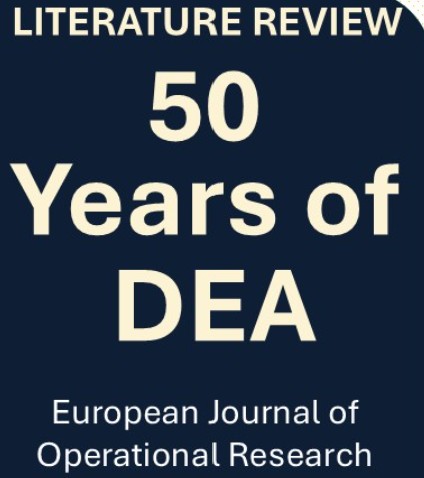
Mergoni, A. A. Emrouznejad, and K. De Witte (2025) Fifty years of Data Envelopment Analysis, European Journal of Operational Research, 326 (3): 389-412. https://doi.org/10.1016/j.ejor.2024.12.049.
CLICK HERE to download review of Fifty years of Data Envelopment Analysis
CLICK HERE to download bibliography (1978-2016)
CLICK HERE to download Supplement with list of over 10,000 articles
biblio
- Gong BH and RC Sickles (1992). “Finite Sample Evidence on the Performance of Stochastic Frontiers and Data Envelopment Analysis Using Panel Data.” J Econometrics 5: 259-284.
- Green R (1996). “Dynamics of Data Envelopment Analysis: Theory of Systems Efficiency – Sengupta,Jk – Book Review.” JORS 4(11): 1421-1421.
- Gong LG and B Sun (1995). “Efficiency Measurement of Production Operations under Uncertainty.” Int J Prod Econ 3: 55-66.
- Gonzalez E and A Alvarez (2001). “From Efficiency Measurement to Efficiency Improvement: the Choice of a Relevant Benchmark.” EJOR 133(3): 512-520.
- Gonzalez E and F Gascon (2004). “Sources of Productivity Growth in the Spanish Pharmaceutical Industry (1994-2000).” Research Policy 33(5): 735-745.
- Gonzalez MD, RA Tapia and RM Thrall (1996). “On the Construction of Strong Complementarity Slackness Solutions for DEA Linear Programming Problems Using a Primal-Dual Interior-Point Method.” Ann Oper Res 66: 139-162.
- Gonzalez XM and D Miles (2002). “Statistical Precision of DEA: A Bootstrap Application to Spanish Public Services.” Appl Econ Letters 9(2): 127-132.
- Golany B and JJ Rousseau (1992). “Efficiency Evaluation Games.” in Phillips FY and JJ Rousseau (eds.) Systems and Management Science by Extremal Methodsboston, Kluwer Academic Publishers.
- Golany B and JE Storbeck (1999). “A Data Envelopment Analysis of the Operational Efficiency of the Operational Efficiency of Bank Branches.” Interfaces 29(3): 14-26.
- Golany B and E Tamir (1995). “Evaluating Efficiency-Effectiveness-Equality Trade-Offs – a Data Envelopment Analysis Approach.” Management Science 4: 1172-1184.