!! Please regularly visit this page as we keep updating it !!

Latest bibliography of DEA with more than 10,000 articles
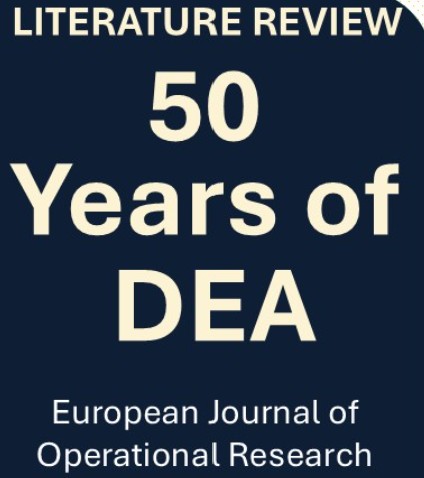
Mergoni, A. A. Emrouznejad, and K. De Witte (2025) Fifty years of Data Envelopment Analysis, European Journal of Operational Research, 326 (3): 389-412. https://doi.org/10.1016/j.ejor.2024.12.049.
CLICK HERE to download review of Fifty years of Data Envelopment Analysis
CLICK HERE to download bibliography (1978-2016)
CLICK HERE to download Supplement with list of over 10,000 articles
biblio
- Grifell-Tatje E and CAK Lovell (2000). “Cost and Productivity.” Managerial and Decision Economics 21(1): 19-30.
- Greer MR (2006). “Are the Discount Airlines Actually More Efficient Than the Legacy Carriers?: A Data Envelopment Analysis.” Int J Transport Economics 33(1): 37-55.
- Gregoriou G, J Messier and K Sedzro (2004). “Assessing the Relative Efficiency of Credit Unionbranches Using Data Envelopment Analysis.” INFOR 42(4): 281-297.
- Gregoriou GN (2003). “Performance Appraisal of Funds of Hedge Funds Using Data Evelopment Analysis.” J Wealth Management 5(4): 88.
- Gregoriou GN (2006). “Optimisation of the Largest US Mutual Funds Using Data Envelopment Analysis.” J Asset Management 6(6): 445-455.
- Gregoriou GN and Y Chen (2006). “Evaluation of Commodity Trading Advisors Using Fixed and Variable and Benchmark Models.” Ann Oper Res 145: 183-200.
- Green RH (1996). “Diy DEA: Implementing Data Envelopment Analysis in the Mathematical Programming Language Ampl.” Omega 24(4): 489-494.
- Gregoriou GN, F Rouah, S Satchell and F Diz (2005). “Simple and Cross Efficiency of Ctas Using Data Envelopment Analysis.” European J Finance 11(5): 393-409.
- Green RH, W Cook and J Doyle (1997). “Note on the Additive Data Envelopment Analysis Model.” JORS 48(4): 446-448.
- Gregoriou GN, K Sedzro and J Zhu (2005). “Hedge Fund Performance Appraisal Using Data Envelopment Analysis.” EJOR 164(2): 555-571.