!! Please regularly visit this page as we keep updating it !!

Latest bibliography of DEA with more than 10,000 articles
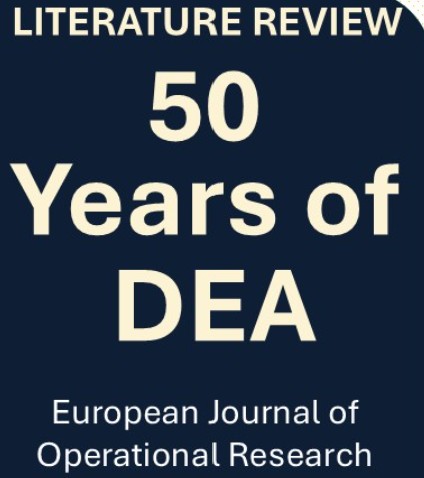
Mergoni, A. A. Emrouznejad, and K. De Witte (2025) Fifty years of Data Envelopment Analysis, European Journal of Operational Research, 326 (3): 389-412. https://doi.org/10.1016/j.ejor.2024.12.049.
CLICK HERE to download review of Fifty years of Data Envelopment Analysis
CLICK HERE to download bibliography (1978-2016)
CLICK HERE to download Supplement with list of over 10,000 articles
biblio
- Nishimizu M and JM Page (1982). “Total Factor Productivity Growth, Technological Progress and Technical Efficiency Change: Dimensions of Productivity Change in Yugoslavia, 1965-78.” Economic Journal 92: 920-936.
- Neralic L and RE Wendell (2004). “Sensitivity in Data Envelopment Analysis Using an Approximate Inverse Matrix.” JORS 55(11): 1187-1193.
- Nesterenko V and V Zelenyuk (2004). “Measuring Potential Gains from Reallocation of Resources.” in Emrouznejad A and V Podinovski (eds.) Proceedings of DEA2004, Birmingham, UK: 243.
- Neto LB, MPE Lins, EG Gomes, JCCBS de Mello and FS Oliveira (2004). “Neural Data Envelopment Analysis: A Simulation.” Int J Industrial Engineering 11(1): 14-24.
- Neff DL, BL Dixon and S Zhu (1994). “Measuring the Efficiency of Agricultural Banks.” American J Agricultural Economics 7: 662-668.
- Neff DL, P Garcia and CH Nelson (1993). “Technical Efficiency – a Comparison of Production Frontier Methods.” J Agricultural Economics 4: 479-489.
- Nelson HJ and KM Nelson (2003). “It: What’s It Good For?” (eds.) Proceedings of 36th Hawaii International Conference on Systems Sciences, IEEE Comput. Soc: 10.
- Nemetz PL and LW Fry (1988). “Flexible Manufacturing Organizations: Implications for Strategy Formulation and Organization Design.” Academy of Management Review 13(4): 627-638.
- Nemoto J and M Goto (1999). “Dynamic Data Envelopment Analysis: Modeling Intertemporal Behavior of a Firm in the Presence Of.” Economics Letters 64(1): 51.
- Nemoto J and M Goto (1999). “Dynamic Data Envelopment Analysis: Modeling Intertemporal Behavior of a Firm in the Presence of Productive Inefficiencies.” Economics Letters 64(1): 51-56.