!! Please regularly visit this page as we keep updating it !!

Latest bibliography of DEA with more than 10,000 articles
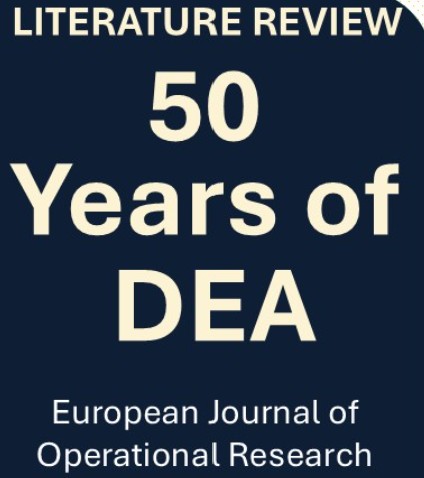
Mergoni, A. A. Emrouznejad, and K. De Witte (2025) Fifty years of Data Envelopment Analysis, European Journal of Operational Research, 326 (3): 389-412. https://doi.org/10.1016/j.ejor.2024.12.049.
CLICK HERE to download review of Fifty years of Data Envelopment Analysis
CLICK HERE to download bibliography (1978-2016)
CLICK HERE to download Supplement with list of over 10,000 articles
biblio
- Johnes J (1996). “Performance Assessment in Higher Education in Britain.” EJOR 89(1): 18-33.
- Johnes J (2006). “Data Envelopment Analysis and its Application to the Measurement of Efficiency in Higher Education.” Economics of Education Review 25(3): 273-288.
- Johnes J (2006). “Measuring Efficiency: A Comparison of Multilevel Modelling and Data Envelopment Analysis in the Context of Higher Education.” Bulletin of Economic Research 58(2): 75-104.
- Jing T and X-y Zeng (2003). ?DEA System and its Application in Weapon System Acquisition.” Systems Engineering and Electronics 25(3): 295-298.
- Jinlong M, DG Evans, RJ Fuller and DF Stewart (2002). “Technical Efficiency and Productivity Change of China’s Iron and Steel Industry.” Int J Prod Econ 76(3): 293-312.
- Jitsuzumi T and A Nakamura (2003). “Measuring DEA Efficiency in Cable Television Network Facilities: What Are Appropriate Criteria for Determining the Amounts of Governmental Subsidies?” Socio-Econ Plan Sci 37(1): 29.
- Joe Z (2003). “Imprecise Data Envelopment Analysis (Idea): A Review and Improvement with an Application.” EJOR 144(3): 513-529.
- Johnes G (1995). “Scale and Technical Efficiency in the Production of Economic Research.” Appl Econ Letters: 7-11.
- Johnes G (1997). “Costs and Industrial Structure in Contemporary British Higher Education.” Economic Journal 107(442): 727-737.
- Johnes G (1998). “The Costs of Multi-Product Organizations and the Heuristic Evaluation of Industrial Structure.” Socio-Econ Plan Sci 32(3): 199-209.