

Lewin AY (1983). “Measuring Routine Nursing Service Efficiency – a Comparison of Costper Patient Day and Data Envelopment Analysis Models – Comment.” HEALTH SERVICES RESEARCH 1: 206-208.
Lewin AY (1984). “Management and Accountability Models of Public Sector Performance.? in Public Sector Performance, a Conceptual Turning Point, Trudi: 224-250.
Lewin AY (1984). “Management and Accountability Models of Public Sector Performance.? in Public Sector Performance, a Conceptual Turning Point, Trudi: 224-250.
Lewin AY (1992). “On Learning from Outliers.” in Rousseau JJ and FY Phillips (eds.) Systems and Management Science by Extremal Methods, Kluwer: 11-17.
Lewin AY (1992). “On Learning from Outliers.” in Rousseau JJ and FY Phillips (eds.) Systems and Management Science by Extremal Methods, Kluwer: 11-17.
Lee YH and P Schmidt (1993). “A Production Frontier Model with Flexible Temporal Variation in Technical Efficiency.” in Fried HO and SS Schmidt (eds.) the Measurement of Productive Efficiency: Techniques and Applications, Oxford U.K.: 237-255.
Lee YH and P Schmidt (1993). “A Production Frontier Model with Flexible Temporal Variation in Technical Efficiency.” in Fried HO and SS Schmidt (eds.) the Measurement of Productive Efficiency: Techniques and Applications, Oxford U.K.: 237-255.
Leem B and C-H Kim (2003). “A Methodology for Designing Multi-Echelon Logistics Networks Using Mathematical Approach.” Int J Industrial Engineering 10(4): 360-366.
Leem B and C-H Kim (2003). “A Methodology for Designing Multi-Echelon Logistics Networks Using Mathematical Approach.” Int J Industrial Engineering 10(4): 360-366.
Leibenstein H and S Maital (1992). “Empirical Estimation and Partitioning of X-Inefficiency: A Data-Envelopment Approach.” American Economic Review 82(2): 428-433.
Leibenstein H and S Maital (1992). “Empirical Estimation and Partitioning of X-Inefficiency: A Data-Envelopment Approach.” American Economic Review 82(2): 428-433.
Leightner JE and T Inoue (2007). “Tackling the Omitted Variables Problem without the Strong Assumptions of Proxies.” EJOR 178(3): 819-840.
Leightner JE and T Inoue (2007). “Tackling the Omitted Variables Problem without the Strong Assumptions of Proxies.” EJOR 178(3): 819-840.
Leitner K-H, M Schaffhauser-Linzatti, R Stowasser and K Wagner (2004). “Revealing the True Story Behind Statistical Information: A Data Envelopment Approach (DEA) to Analyse Austria’s University?s Research Performance.” in Emrouznejad A and V Podinovski (eds.) Proceedings of DEA2004, Birmingham, UK: 330.
Leitner K-H, M Schaffhauser-Linzatti, R Stowasser and K Wagner (2004). “Revealing the True Story Behind Statistical Information: A Data Envelopment Approach (DEA) to Analyse Austria’s University?s Research Performance.” in Emrouznejad A and V Podinovski (eds.) Proceedings of DEA2004, Birmingham, UK: 330.
Lelas V and T Sueyoshi (1997). “Goal Programming Models and Their Duality Relations for Use in Evaluating Security Portfolio and Regression Relations.” EJOR 98(2): 431-443.
Lelas V and T Sueyoshi (1997). “Goal Programming Models and Their Duality Relations for Use in Evaluating Security Portfolio and Regression Relations.” EJOR 98(2): 431-443.
Leleu H (2006). “A Linear Programming Framework for Free Disposal Hull Technologies and Cost Functions: Primal and Dual Models.” EJOR 168(2): 340-344.
Leleu H (2006). “A Linear Programming Framework for Free Disposal Hull Technologies and Cost Functions: Primal and Dual Models.” EJOR 168(2): 340-344.
 Download
Mergoni, A. A. Emrouznejad, and K. De Witte (2025) Fifty years of Data Envelopment Analysis, European Journal of Operational Research, 326 (3): 389-412, https://doi.org/10.1016/j.ejor.2024.12.049.

DEA Workshop: Efficiency and Productivity Assessment in Higher Education and Public Services: DEA, Machine Learning, and AI, April 16-17, 2026, Aston University, UK
 DEA Course (CLICK HERE)
Dates:
Friday, June 12, 2026 – 10.00 to 17.30 (UK time)
Saturday, June 13, 2026 – 10.00 to 17.30 (UK time)
Presenters:
Professor Emmanuel Thanassoulis &
Professor Ali Emrouznejad
by Ali Emrouznejad & Rajiv Banker


William W Cooper
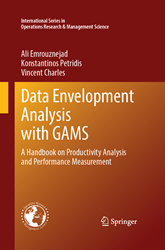
Order at Amazon – Download GAMS codes
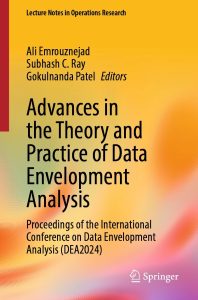 Download
 Download
Performance Improvement Management Software – PIM-DEA software
Managing Service Productivity : Uses of Frontier Efficiency Methodologies and MCDM for Improving Service Performance, Springer

Order at Amazon

Download | Recommend to Library
LinkedIn | Facebook | Twitter
 Download
Performance Measurement with Fuzzy DEA, Springer

Order at Amazon
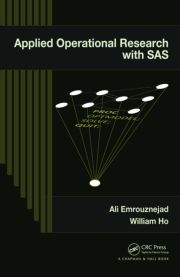
Order at Amazon
Strategic Performance Management &
Measurement Using DEA. IGI Global, USA.

Order at Amazon